


How to Build a 7-Figure
Online Course in 2026
I scaled past $600K/month selling courses — working 2-3 hours a day.
Here's the exact process, step by step.
By Sander Stage | 12 min read | March 2026
Most people believe you need a massive audience, a full sales team, and years of experience to make real money selling online courses. That belief is wrong — and it's costing you time.
Last year, I scaled my online course business past $600,000 in monthly profit, working just two to three hours per day, without complex backend systems or a huge following. In this post, I'm breaking down the exact six steps that made it possible — and how you can replicate them regardless of what you teach.
Whether your expertise is in fitness, photography, finance, music, consulting, or even something as niche as wine tasting, this blueprint works. There are million-dollar courses being sold on virtually every topic you can imagine. And the best part? You don't need to be the world's foremost expert to get started.
Whether you're aiming to create & launch your first online course from scratch, or to scale an existing online course to $100K/month and far beyond - we have courses, services & systems to accommodate your needs!
How I Made $650K in One Month Selling Courses — Zero Sales Calls
Real payment dashboards. No fabricated screenshots. Plus the 4 raw rules that actually got me here — and can get you there too.
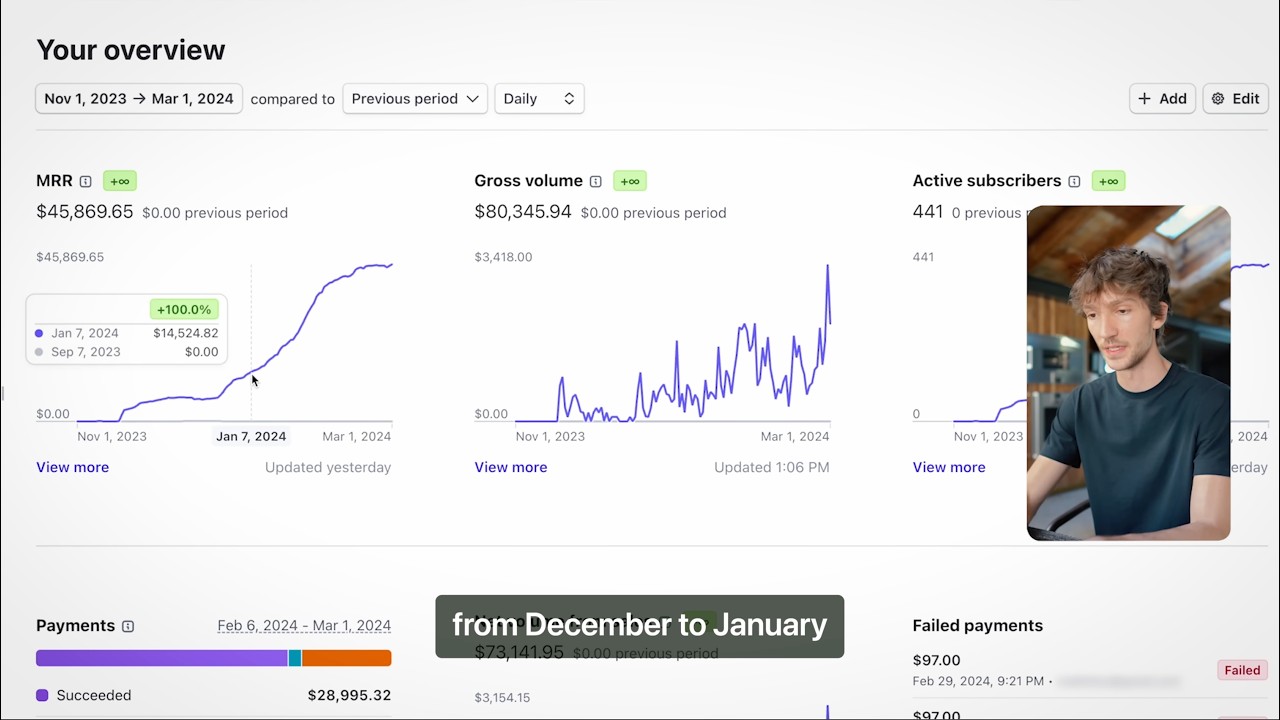
About a year ago, I posted a video called Raw Reality of Making $500,000 Per Month. It got over 300,000 views, sparked a wave of imitation content, and generated more questions about income proof than anything else I've ever published.
Since then, I've been quiet — not because the business slowed down, but because I'm a product guy at heart. When things are working, I put my head down and make them better. What I haven't done is come back to actually show you what happened to those numbers over the year that followed. So that's what this post is.
I'm going to show you exactly what the dashboard looked like during the period I made that original video — updated, transparent, and with the full breakdown. And then I'm going to share four pieces of advice that I genuinely believe are more important to your success than any tactic or system I could ever teach you.
The NumbersThe Real $650K Breakdown
Let's go to the data. Looking at the period from late December 2023 through January 23rd, 2024 — roughly five weeks — here's what the dashboards showed:
Course platform — gross volume: $500,000. Net volume after processing fees and refunds: $460,000. That's what actually landed.
But that's not the complete picture. A portion of students paid in three split payments. Only the first installment gets counted in the initial gross volume, which means roughly two additional installments — approximately $160,000 — were still incoming. Being conservative, that adds another $150,000 to the real revenue figure for that period.
On top of that, during the same four-week window, a separate recurring revenue stream from a complementary business added another $45,000 per month — and unlike course sales, that one just repeats automatically every month without additional effort.
So when you add it all together: $460K in net course revenue + $150K in split payment tails + $45K in recurring revenue = approximately $650,000 for that period. Comfortably closer to $700,000 when you look at it on a monthly annualized basis.
I'm not telling you this to brag. I'm telling you this because I said "$500K per month" in a video and I want to show you that if anything, I was underselling it. The numbers were real. They were documented. And in many months, they were higher.
The MindsetYour laptop and your phone are remote controls to the video game called life. How well you play your character determines your level in the game.
Why Life Is the Most Fair Game You Can Play
I grew up playing video games — embarrassingly so. World of Warcraft, League of Legends, Counter-Strike. I've calculated that I put in close to a year of in-game time across those three games alone. 365 days of actual play.
But there's a concept from gaming that I think applies directly to building a business — and it's one of the most honest frameworks I've found for thinking about success. When you play a video game, you're dealt a character with a certain set of stats. Some characters are faster. Some hit harder. Some have abilities others don't. And the goal is not to wish you had a different character. The goal is to figure out how to win with the one you have.
Life works the same way. We're all dealt a hand of cards. Some people are born with wealth. Some are born into struggle. Some have natural advantages that others have to build over years. That's real, and I'm not going to pretend it isn't. But within that reality, I genuinely believe that any hand of cards can be played into a winning hand. It just depends how honestly you understand your own strengths and weaknesses — and how relentlessly you play them.
The mistake most people make is comparing their hand to someone else's and wondering why they can't get the same results with the same moves. You can't. You have different cards. Stop using their map to navigate your terrain.
4 RulesThe Four Rules That Actually Built This
I could talk about funnels, pricing, VSLs, YouTube strategy, email sequences, and offer positioning. And all of that matters. But none of it matters if you don't have these four things right first.
Believe You Can Actually Do It
I know how that sounds. Cliché. Something a motivational poster would say. But I mean it in a very specific, concrete way. I have met people with genuinely exceptional intelligence who are not succeeding in business — because they fundamentally don't believe they can. And I've met people with average intelligence who have built remarkable things — because they do. The difference isn't talent or IQ or connections. It's conviction. You will only achieve what you wholeheartedly believe you can achieve. That's not inspiration — that's just what I've consistently observed.
Act Like Someone Who Deserves It
The people who are where you want to be did not get there by watching lifestyle vlogs and motivational reels. They watched the boring 3-hour founder podcast with 300 views. They bought the course that wasn't flashy but contained genuine technical knowledge. They invested in mentorship and studied the mechanics of what actually works — not what's trending. If you consume what the masses consume, you get what the masses get. The real gold on YouTube is often in videos with 500 views that go deep on a specific, technical problem. That's what the successful people are actually watching. Act accordingly.
Cut the BS — Stop Talking About Your Plans
Sharing your goals and visions with friends and family feels productive. It isn't. Research has shown that talking about your goals gives you a dopamine hit similar to actually achieving them — which means you burn off motivation before you do the work. Write your goals down. Read them every morning. I read through my vision statement, my annual goals, my 3-year and 5-year targets every single morning — it takes about two minutes. Then a short journal entry. Then three minutes of meditation. And then I lock in. The vision stays in my head. Not in conversation.
Own Your Journey — Stop Comparing
This is the hardest one for most people, especially in an era of constant social comparison. Someone else's success was built on their specific hand of cards — their network, their starting point, their specific skill set, their timing. Seeking technical knowledge from people who have succeeded? Smart. Copying their exact path and expecting it to work for your situation? Unlikely. Your job is to figure out what your unique set of strengths enables you to do — and then do that with relentless consistency. It won't look like anyone else's path. That's not a flaw. That's the point.
The One Thing That Made All of This Possible
I've made over $10 million in profit from online courses over the past five years. I want to be honest about something: I didn't make that money by teaching people to make money from courses. I made it by teaching skills — business skills, marketing skills, agency-building skills — in a format that scaled. The course business came first. Teaching others how to replicate it came much later, after years of refining a model that I knew actually worked.
What unlocked everything was a simple decision: stop trading time for money, and start packaging what I know into something that can reach thousands of people without requiring my time for each one. That's what an online course does. And with the right funnel, the right traffic source, and the right positioning, it becomes a machine that runs without sales calls, without a sales team, and without you being on the phone all day.
If you're looking for where to start, the Course Creator Launchpad is the most complete version of everything I know — built from the ground up for people starting from zero. No sales calls required to buy it either.
The Course Creator Launchpad shows you how to use AI to build, launch, and scale your first online course — zero experience required, no sales calls needed.
Create Your Course With AI — $39Lifetime Access · Money Back GuaranteeFrequently Asked Questions
Yes, with the right offer, funnel, and traffic source. This revenue came from a combination of course sales (with split payment tails factored in) and monthly recurring software revenue — all documented in real payment dashboards with specific figures shared in this post.
No — not for low-to-mid-ticket courses. These typically convert through a video sales letter (VSSL) and a checkout page alone. Sales calls are generally reserved for high-ticket offers above $3,000–$5,000, where the buyer needs more conviction before committing.
Conviction in yourself and relentless discipline. These two factors consistently outperform IQ, connections, and starting capital in determining who actually succeeds at building an online business from scratch.
Recognize that every person is playing with a different hand of cards. Their success is built on their specific strengths and circumstances. Study their tactics and technical knowledge — but stop trying to replicate their exact path. Your job is to figure out how to win with your hand.
Generally no. Research shows that talking about your goals provides a similar dopamine hit to achieving them — which reduces your motivation to do the actual work. Write your goals down, read them daily, keep them to yourself, and channel that energy into execution.
It means consuming information and taking actions consistent with someone who is already at the level you want to reach. Invest in courses and mentorship. Watch the dense, boring founder podcasts with 300 views. Skip the viral lifestyle content. The people who succeed consume what others won't.
Start with a morning routine anchored in your vision: read your goals, write a short journal entry, and meditate for 3 minutes. This takes under 10 minutes and signals to your brain that the day has direction and purpose. Discipline follows clarity of purpose.
Yes — arguably more than ever. You have internet-connected devices that give you access to the entire world's knowledge and customer base. Most of the population is distracted by cheap dopamine and poor habits. If you show up consistently with genuine value and real discipline, the gap you can close is enormous.
Ready to Build Your Course?
Learn how to create and sell your first online course using AI — build your funnel, drive organic traffic, and generate passive income on autopilot.
One-time payment (save 90%)
- 9 in-depth course chapters.
- Private Members' Community.
- Templates & systems for everything.
- No previous experience required.
My Social Medias


Support & Login
Legal Pages

© 2025 Course Creator Co.
All Rights Reserved